

Brazil can share its success in reducing flaring from oil & gas operations
EnergyCC and CGD joint project conducted the preliminary scoping study on gas flaring and country trends
The preliminary scoping study on gas flaring and country trends found that Brazil has been successful in reducing the volume of gas flared in the oil and gas sector, even with increased production. Overall performance compares very well with other producing countries with low flaring intensity (Figure 1). Satellite derived flaring data show that Brazil’s performance trend of flaring vs oil production is similar to that of the UK, Canada, and Saudi Arabia.
Figure 1
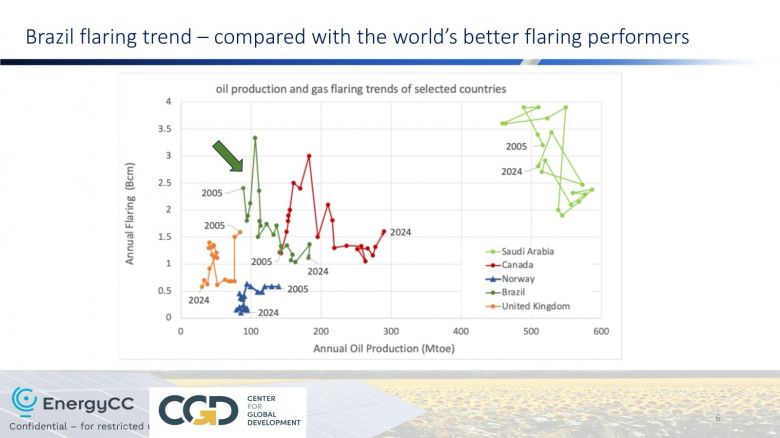
Source EnergyCC analysis
Brazil has successfully contained the flare rates of its flares. Gas flared in Brazil decreased from 1.79 billion cubic meters (bcm) in 2012 to 1.11 bcm in 2024, even while oil production increased by 62% in the same period. Although most of Brazil’s flares are related to upstream oil and gas activities, 18 of its 106 flares are associated with onshore refinery activities. This commendable downward trend runs counter to global trends on gas flaring, which increased in both 2023 and 2024 to the highest levels since 2007 (Figure 2).
Figure 2
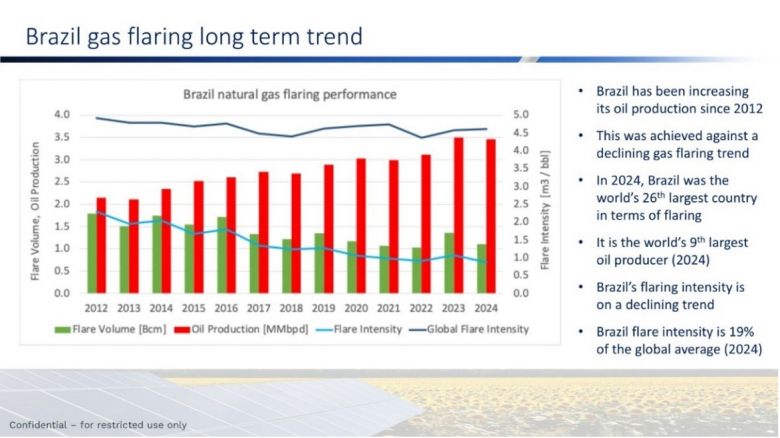
Source: EnergyCC analysis
Brazil had just one super-emitter (defined as ranked in the global top 300 flares) in 2017, 2018, and last in 2020. In 2024, Brazil had only one large flare at a rate of 5.2 million standard cubic feet per day (MMscf/d), which ranked 650th globally. The largest Brazil flares were located offshore.
Petrobras, Brazil’s National Oil Company, produces 73 percent of the country’s oil and gas. To support Brazil’s climate goals, Petrobras aims for net-zero emissions by 2050, linking executive compensation to emissions reduction. The company is expanding production while minimizing environmental impact.
With most existing producing basins now more mature, focus is shifting to frontier regions with proven hydrocarbon plays, such as the Amazon.
Petrobras’ experience offers valuable lessons for over 60 oil-producing countries seeking to decarbonize operations and reduce flaring and venting, practices that currently waste roughly 8% of global natural gas, valued at more than US$100 billion annually.
Share this article


Read Other Blogs
Oct 01, 2026 • Oil & Gas Industry
A performance-based fiscal element (e.g. methane rebate fee) should be designed to make gas capture more profitable than flaring
Sep 28, 2026 • Oil & Gas Industry
EnergyCC developed a four-point approach, combining: measurement, transparency, fiscal / regulatory measures, and gas monetisation to reduce emissions.
Sep 23, 2026 • Oil & Gas Industry
The CGD-EnergyCC project has published a Literature Review on the Health Impacts of Natural Gas Flaring in emerging market economies.
