

Methane emissions from natural gas flaring and venting are primarily a public health issue, not just a climate issue
The CGD-EnergyCC project has published a Literature Review on the Health Impacts of Natural Gas Flaring in emerging market economies.
Methane emissions are best known for driving rapid near-term global warming. Yet the largest immediate benefits of reduced flaring may be improvements in human health, as demonstrated in EnergyCC’s earlier work. Communities living near oil and gas operations can be exposed to pollutants associated with premature death, due to heart disease and stroke, respiratory diseases, and cancer.
Most flares do not reach a 100% combustion target where all hydrocarbons are destroyed. If flare gas is not fully combusted, a range of chemicals is produced that are toxic to human health, as well as affecting air quality and climate (Figure 1).
The impacts of these chemicals can be estimated as the social cost of atmospheric release (SCAR). EnergyCC [1], uses a methodology developed by Shindell that integrates impacts in four areas into a single SCAR measure:
The SCAR results show that methane (CH4) emissions from flaring and venting have a far greater social cost than carbon dioxide (CO2). Methane also has a greater impact on human health than on climate.
Figure 1
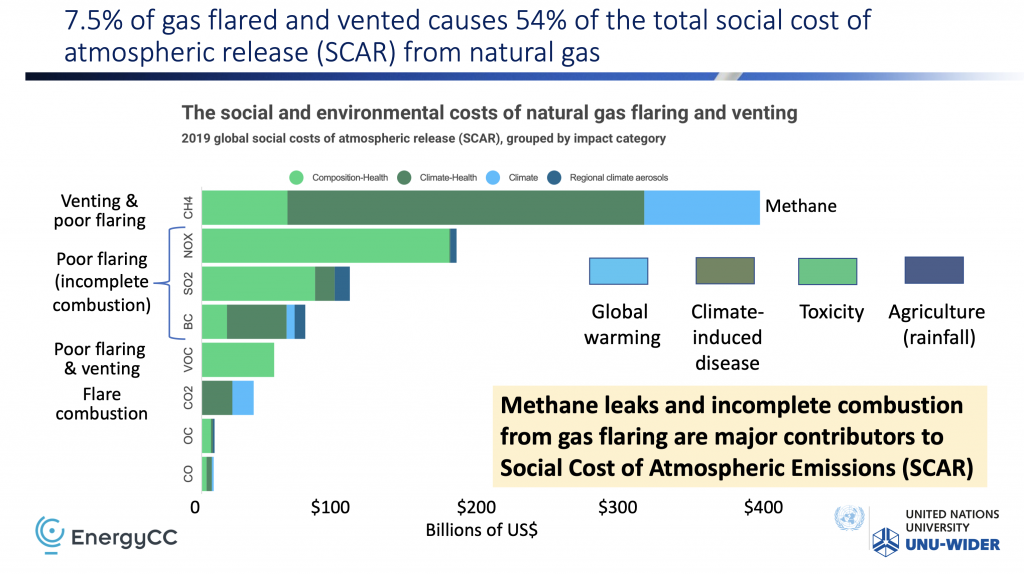
Source: EnergyCC analysis
Investigations by the BBC https://youtu.be/9th-_GpIm-A included their own monitoring and assessment program of 52 children living within 10 km from gas flares, together with air samples near 5 different oil fields in Southern Iraq. The BBC undertook new research from Iraq, Iran and Kuwait suggests that pollutants from flaring are not just affecting local communities living and working close the flare sites, but spreading hundreds of miles, worsening air quality across the entire region.
Although the negative impact on gas flaring on health is now generally accepted, more needs to be done to communicate the severity of the situation. In 2022, the Iraqi Environment Minister acknowledged to the BBC that ‘that pollution from oil production is the main reason for increases in local cancer rates’. The WHO confirms that some 68% of outdoor air pollution related premature deaths were due to ischaemic heart disease and stroke, 14% were due to chronic obstructive pulmonary disease, 14% were due to acute lower respiratory infections.
The CGD-EnergyCC project has just published a Literature Review on the Health Impacts of Natural Gas Flaring in emerging market economies. CGD-EnergyCC’s larger proposed project seeks funding to develop a methodology to assess the impact of flaring on community health by integrating flaring emission data with health modeling tools. Fiscal measures in combination, can reduce natural gas flaring and venting, and enhance health outcomes.
[1] Romsom E, McPhail K. (2021). Capturing economic and social value from hydrocarbon gas flaring and venting: solutions and actions. WIDER Working Paper 2021/6. Helsinki: UNU-WIDER. https://doi.org/10.35188/UNU-WIDER/2021/940-2 .
Share this article


Read Other Blogs
Oct 01, 2026 • Oil & Gas Industry
A performance-based fiscal element (e.g. methane rebate fee) should be designed to make gas capture more profitable than flaring
Sep 28, 2026 • Oil & Gas Industry
EnergyCC developed a four-point approach, combining: measurement, transparency, fiscal / regulatory measures, and gas monetisation to reduce emissions.
May 01, 2026 • Oil & Gas Industry
EnergyCC and CGD joint project conducted the preliminary scoping study on gas flaring and country trends
